
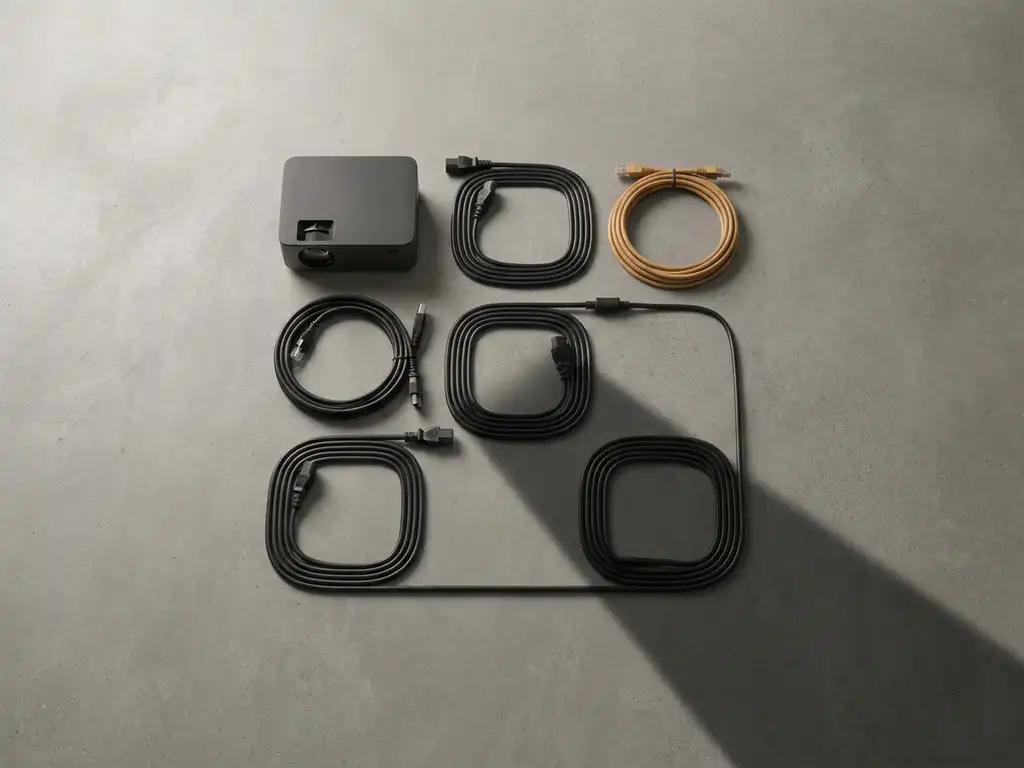
Immersive installations require a combination of projection or display systems, spatial audio, computing hardware, structural infrastructure, and often sensor or interaction technology working in concert. The exact technical requirements depend on the scale, format, and interactivity level of the experience, but every installation shares a common foundation: the physical environment and digital content must be engineered together from the start. The sections below break down each layer of that technical foundation in detail.
What types of technology make up an immersive installation?
An immersive installation is built from several interconnected technology layers: projection or LED display systems, spatial audio hardware, real-time rendering engines, interactive sensors, and control infrastructure that ties everything together. No single piece of technology creates immersion on its own. It is the precise integration of these systems, calibrated to work as one seamless environment, that produces a genuinely immersive experience.
At the visual layer, most large-scale installations rely on high-lumen laser projectors, LED panels, or a combination of both. Projection is preferred for curved, irregular, or architecturally complex surfaces, while LED panels offer brightness advantages in environments where ambient light cannot be fully controlled. For smaller or more intimate experiences, OLED displays or head-mounted devices such as VR headsets or the Apple Vision Pro introduce an entirely different visual paradigm.
The rendering layer sits beneath the visuals. Software environments such as Unreal Engine or Unity generate the content in real time, allowing the installation to respond dynamically to inputs rather than playing back a fixed video file. This distinction matters enormously for interactive installations, where the experience must branch, adapt, or react to visitors.
Beyond visuals and audio, multisensory installations incorporate scent diffusion systems, haptic surfaces, temperature control, and spatial lighting rigs. These elements are not decorative additions. They activate the nervous system in ways that visual media alone cannot, which is why we design with all the senses as a deliberate creative and technical strategy.
What space and infrastructure do immersive installations require?
Immersive installations require spaces with controlled lighting, sufficient ceiling height, stable power supply, and surfaces or structures capable of supporting projection or display mounting. The minimum viable space varies by format, but as a general principle, the environment is not just a backdrop. It is an active component of the experience that must be assessed and often modified before installation begins.
Ceiling height is one of the most critical spatial variables. Dome-format or full 360-degree projection environments typically require a minimum of five to six metres of clearance, while floor-level or wall-based installations can operate in standard commercial ceiling heights. Irregular or low ceilings are not necessarily disqualifying, but they demand custom projection mapping solutions and more complex calibration.
Structural load capacity matters when rigging projectors, speakers, or physical set elements from the ceiling. Any venue being considered for a permanent or semi-permanent installation should undergo a structural survey before technical design is finalised. For touring installations, this survey becomes part of the advance production process at each venue.
Light control is equally non-negotiable for projection-based experiences. Even modest ambient light can wash out projected imagery, reducing contrast and breaking immersion. Blackout curtains, sealed doorways, and controlled entry points are standard requirements. LED-based installations are more tolerant of ambient light, which is one reason they are increasingly preferred for public-facing or outdoor settings.
How much computing power does an immersive installation need?
The computing power required for an immersive installation scales directly with the resolution, frame rate, interactivity, and number of simultaneous outputs the system must drive. A single-screen passive experience has modest demands, while a multi-channel real-time interactive installation across a 360-degree environment can require a cluster of high-performance workstations running in parallel.
For real-time rendered environments, the GPU is typically the most critical component. Professional-grade graphics cards capable of driving multiple outputs at high resolution are standard in serious installations. When a single machine cannot handle the full rendering load, render nodes are networked together and synchronised through dedicated media server software such as Disguise, Resolume, or Notch.
Latency is the hidden enemy of interactive computing in immersive contexts. When a visitor’s movement or gesture triggers a visual or audio response, that response must occur within milliseconds to feel natural. Any perceptible delay breaks the sense of presence. This means computing infrastructure must be sized not just for average load, but for peak simultaneous demand across all interactive touchpoints.
For AI-driven elements such as responsive avatars or adaptive narrative systems, additional processing capacity is required, sometimes offloaded to cloud infrastructure where real-time latency tolerances allow. The decision between on-site and cloud-based computation is a technical design choice made early in the project, as it affects networking requirements, reliability planning, and content architecture.
What are the audio requirements for a fully immersive experience?
A fully immersive audio experience requires a spatial audio system, typically built on object-based audio formats such as Dolby Atmos or ambisonics, delivered through a speaker array positioned to surround and envelop the audience from all directions, including above. Standard stereo or even 5.1 surround sound is insufficient. True immersive audio places sound in three-dimensional space so that it moves, originates from specific locations, and responds to where the listener is standing.
The number and placement of speakers depends on the room geometry and the intended audio behaviour. A dome or circular space requires a minimum ring of speakers at ear height supplemented by elevated or overhead drivers. Irregular spaces require acoustic modelling before speaker positions are finalised, as reflective surfaces, hard floors, and exposed concrete can introduce echo and frequency buildup that undermine the experience.
Subwoofer placement is a separate consideration. Low-frequency sound is felt as much as it is heard, and in a multisensory installation, bass energy contributes directly to the physical sensation of immersion. Subwoofers must be positioned to distribute low-end evenly without creating standing waves in specific areas of the room.
For installations where visitors move freely rather than standing in a fixed position, binaural audio or head-tracked spatial audio becomes relevant. This is particularly true in VR and mixed reality contexts, where audio must update in real time to match the listener’s head orientation. The technical pipeline for head-tracked audio is more complex than fixed spatial audio and requires tight integration between the tracking system and the audio engine.
How do interactive and sensor-based elements change the technical setup?
Adding interactivity to an immersive installation introduces an entirely new technical layer: sensing, processing, and responding. The installation must now detect visitor presence, movement, or input in real time and translate that data into changes in the visual, audio, or physical environment. This transforms the technical architecture from a playback system into a responsive, event-driven system.
Types of sensors commonly used
Depth cameras such as LiDAR or time-of-flight sensors track body position and movement without requiring visitors to wear or carry any device. Infrared sensors detect proximity and presence. Pressure-sensitive floors register footsteps and weight distribution. Capacitive touch surfaces respond to direct contact. Each sensor type has different range, resolution, and environmental sensitivity characteristics, and the choice depends on the interaction design.
Real-time processing and response architecture
Sensor data must be processed fast enough to produce responses that feel instantaneous. This typically requires a dedicated processing layer sitting between the sensor hardware and the rendering engine, often running custom middleware or game engine logic that maps sensor inputs to content triggers. The more complex the interaction logic, the more robust this middleware layer must be. Stress testing under realistic visitor loads is essential before any public opening.
Physical interactive elements such as buttons, levers, or custom props introduce additional integration requirements. These objects must be wired or wirelessly connected to the control system, and their physical durability must be rated for continuous public use. A prop that works perfectly in a studio environment can fail within hours under the wear of a busy exhibition.
What connectivity and networking infrastructure is needed on-site?
An immersive installation requires a dedicated, high-bandwidth local area network connecting all rendering machines, media servers, sensor systems, and control interfaces. This network must be isolated from general public or venue Wi-Fi to prevent interference, bandwidth competition, or security vulnerabilities. For most professional installations, a wired gigabit or ten-gigabit Ethernet backbone is the standard foundation.
Wireless connectivity is used selectively, primarily for visitor-facing interactive elements such as smartphones, tablets, or wireless controllers where running cables is impractical. Wireless systems introduce latency and reliability variables that wired systems avoid, so any wireless component in a critical signal path requires careful planning, redundancy, and testing under realistic RF conditions.
For installations that incorporate cloud-based AI, live data feeds, or remote monitoring, a dedicated internet connection with guaranteed bandwidth and low latency is required. This connection should be separate from any venue-wide internet provision and ideally backed by a secondary failover connection. Dependence on a shared venue network for mission-critical functions is a risk that professional installations do not accept.
Network time synchronisation is a technical detail that is easy to overlook but critical in multi-machine environments. When several computers are driving different outputs simultaneously, they must share a common time reference to stay frame-accurate. Protocols such as PTP or NTP are used to synchronise clocks across the network, ensuring that visual and audio outputs remain locked together even under processing load.
Which technical requirements differ between permanent and touring installations?
Permanent installations are engineered for a specific environment and can be optimised fully for that space, while touring installations must be designed for rapid deployment, adaptability across varying venues, and resilience to repeated assembly and disassembly. These two contexts produce fundamentally different technical priorities even when the creative experience is identical.
Permanent installations benefit from fixed cable runs, custom mounting structures, and venue-specific acoustic treatment. The technical system can be tuned precisely to the room over time, and maintenance access can be built into the architecture. The initial technical investment is higher, but the ongoing operational complexity is lower once the installation is calibrated and stable.
Touring installations prioritise portability, modularity, and speed. Every component must pack into road cases rated for transport, connect through standardised connectors, and be assembled by a crew working within a defined production window. This places constraints on the physical size and weight of hardware, the complexity of cabling, and the tolerance for bespoke or fragile components.
Technical documentation becomes a critical deliverable for touring productions. Detailed setup guides, calibration files, and troubleshooting protocols must travel with the installation so that local crews in different cities or countries can operate and maintain the experience consistently. The difference in visitor experience between a well-documented touring installation and a poorly documented one is significant and often invisible until something goes wrong.
Power requirements also diverge between permanent and touring contexts. A permanent installation can be wired directly into a building’s electrical infrastructure with dedicated circuits. A touring installation must work within the power provisions of each venue, which vary considerably, and must carry its own power distribution equipment to ensure consistent, clean power to sensitive electronics.
If you are planning an immersive installation, whether permanent, touring, or somewhere between, the technical requirements are best resolved through early collaboration with a team that designs both the creative experience and the technical architecture together. We approach every project this way, ensuring that the technology serves the story rather than constraining it. If you would like to explore what your project requires, we invite you to contact us and start the conversation.
Gerelateerde artikelen
- How can a show improve the overall visitor experience?
- What is an immersive art installation?
- What is the difference between brand activation and brand experience?
- What are the benefits of experiential marketing?
- What is the strongest trigger to memory?
- What are the three levels of immersion?
- What is an immersive experience?
- How do brands use immersive installations for marketing?
- Should I use AR filters for my product launch?